In brief
- At 21°C, modern broilers typically consume about 1.6–1.8 L of water per kg of feed; deviations in water use can precede visible performance problems.
- A 2025 broiler study found that water with TDS above 3,000 mg/L reduced feed intake and body-weight gain during the first 21 days, although amino acid digestibility and overall FCR were not significantly changed.
- A clean source does not guarantee clean water at the bird: storage tanks, warm drinker lines, scale and biofilm can materially change microbiological quality before water reaches the nipple.
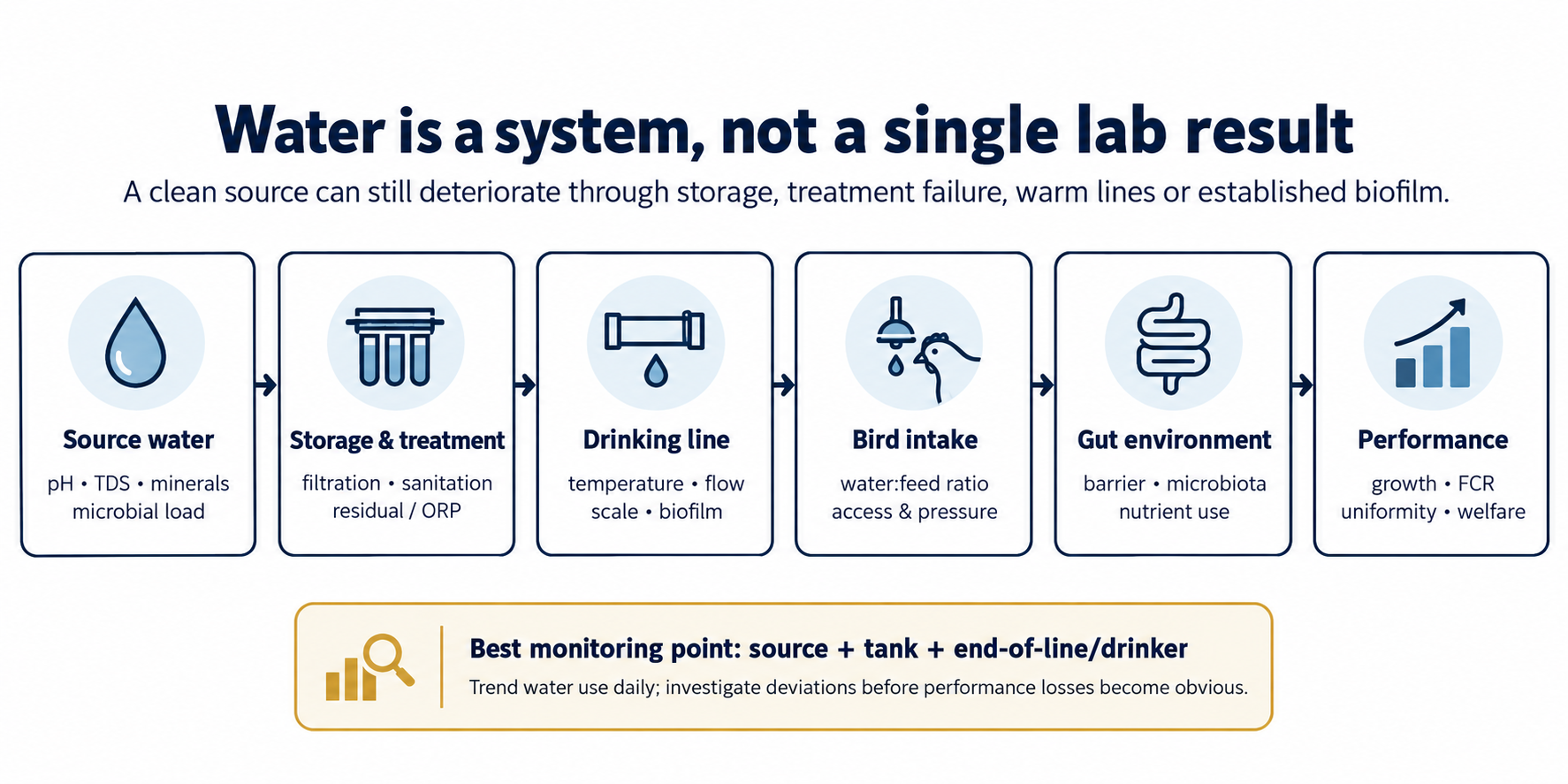
- Water management should be treated as an integrated system: source chemistry, sanitation, line hygiene, temperature, flow and daily consumption trends must be interpreted together.
The performance equation is not feed alone
Feed formulation receives enormous technical attention in commercial broiler production. Energy, digestible amino acids, minerals, enzymes and feed-additive matrices may be calculated to a high degree of precision. Water, however, is frequently treated as infrastructure rather than nutrition. That is a management error.
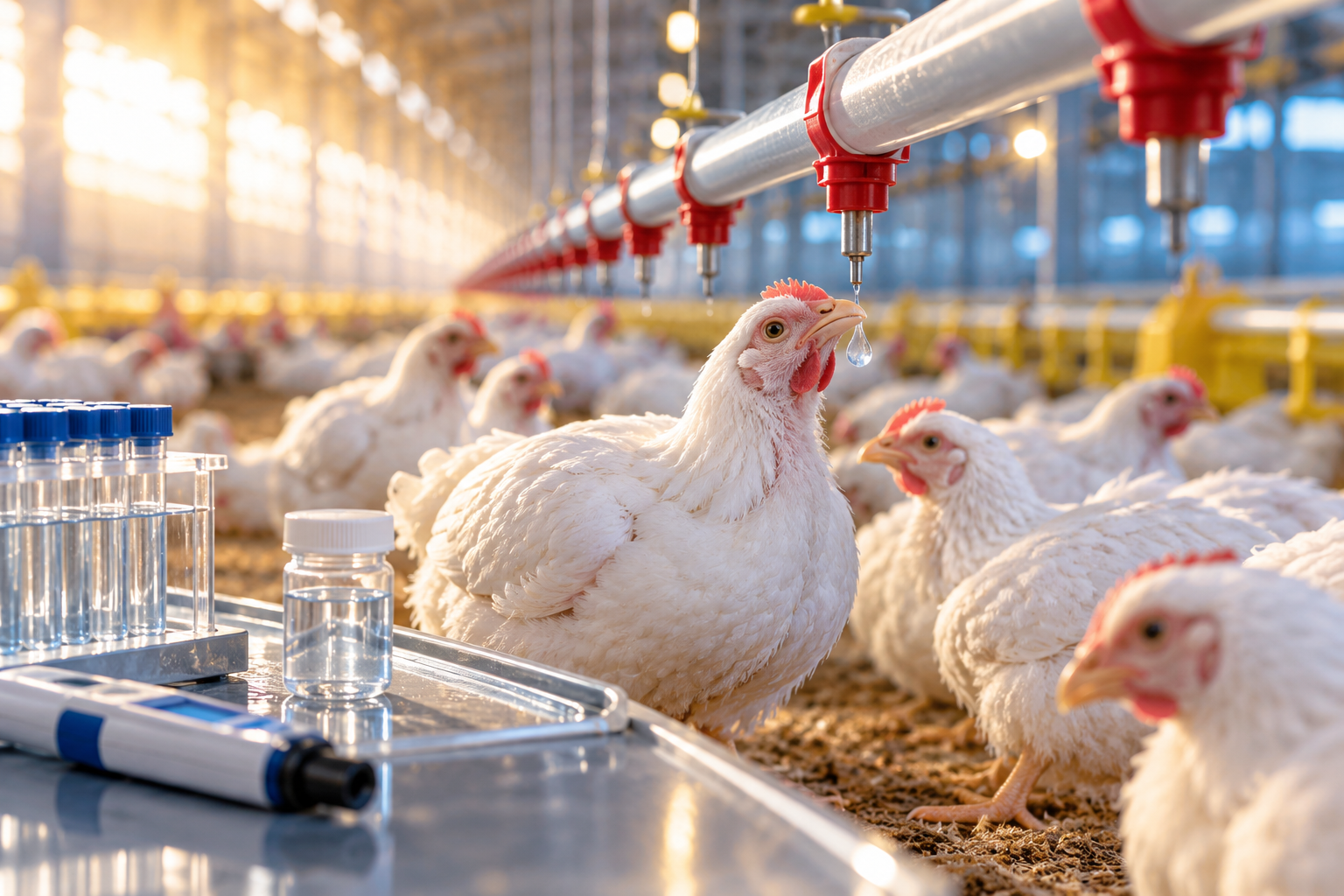
The Ross Broiler Management Handbook 2025 recommends unrestricted access to clean, fresh water and notes that, at 21°C, a water-to-feed ratio close to 1.6–1.8 L/kg is typical when birds are consuming adequatelyj. Water demand rises with ambient temperature, and changes in daily water use can be an early warning of health, equipment or environmental problems [4].
Water is therefore both a nutrient and a diagnostic signal. It supports digestion, nutrient transport, thermoregulation and waste excretion, but it also carries vaccines, medications and increasingly a range of nutritional or gut-health interventions. If water quantity, quality or delivery is unstable, the biological response to a well-designed feeding program can become less predictable.
What recent research shows about water chemistry
Water chemistry matters, but individual parameters should not be interpreted in isolation. In a 2025 Poultry Science trial, Raut and colleagues compared municipal water, well water With moderately elevated mineral content, high-pH water, and high-TDS water (>3,000 ppm) in male Cobb 500 broilers through day 21 [2]. The high-TDS treatment reduced overall feed intake and body-weight gain. Importantly, however, apparent ileal amino acid digestibility and overall FCR were not significantly different among treatments.
That distinction matters. It is tempting to explain every water problem through impaired digestion, but the evidence can point to more direct pathways such as palatability, osmotic load, altered water/feed intake, wet litter risk or interaction with the delivery system. The same trial also showed why one abnormal laboratory value should not automatically be blamed for poor performance: the high-pH treatment did not reproduce the same growth depression as high TDS.
Recent reviews now frame poultry water quality as an integrated combination of microbiological control, physicochemical stability and functional effects on bird performance rather than a single threshold-based problem [1]. In practice, the interpretation of pH, hardness, iron, sulfate, chloride and TDS should consider the water source, diet, sanitation program, equipment and local conditions.
Operational checkpoints for broiler drinking water
The values below are management benchmarks drawn mainly from current Aviagen and Cobb technical guidance. They are not universal legal limits and should be interpreted alongside local regulation, laboratory methods and the specifications of sanitation or dosing equipment.
| Parameter | Operational benchmark | Why it matters |
|---|---|---|
| Total dissolved solids (TDS) | <1,000 mg/L: good 1,000–3,000: generally acceptable with caution >3,000: performance risk increases |
High salinity/mineral load can alter intake, litter moisture and early growth. |
| pH | 6.5–8.5: satisfactory baseline for source-water assessment | Affects palatability, corrosion and sanitizer performance. Purposeful acidification programs may use a lower target and must be managed separately. |
| Coliforms | 0 CFU/mL ideal | Any detection warrants investigation of source, storage and/or line hygiene. |
| Iron | <0.3 mg/L preferred | Higher iron can promote deposits, staining and microbial growth; it can also complicate sanitation. |
| Sulfate | <200 mg/L preferred | Higher concentrations can have a laxative effect, especially with elevated sodium or magnesium. |
| Chloride | <250 mg/L preferred | High chloride, especially together with sodium, can increase salinity and wet-litter risk. |
| Hardness | Monitor scale formation rather than relying on one universal threshold | Hardness is not necessarily toxic to birds, but scale can restrict lines and interfere with cleaning or dosing. |
| Nitrate nitrogen | <10 mg/L as nitrate-N | Elevated nitrate can indicate contamination and deserves investigation. |
| Water temperature | 18–21°C ideal in many broiler situations | Warm water can reduce intake, favor microbial growth and make line hygiene more difficult. |
| Water:feed ratio | About 1.6–1.8 L/kg at 21°C under normal conditions | A daily trend metric; sudden changes can reveal health, environment or equipment problems. |
Biofilm: the hidden difference between source water and bird water
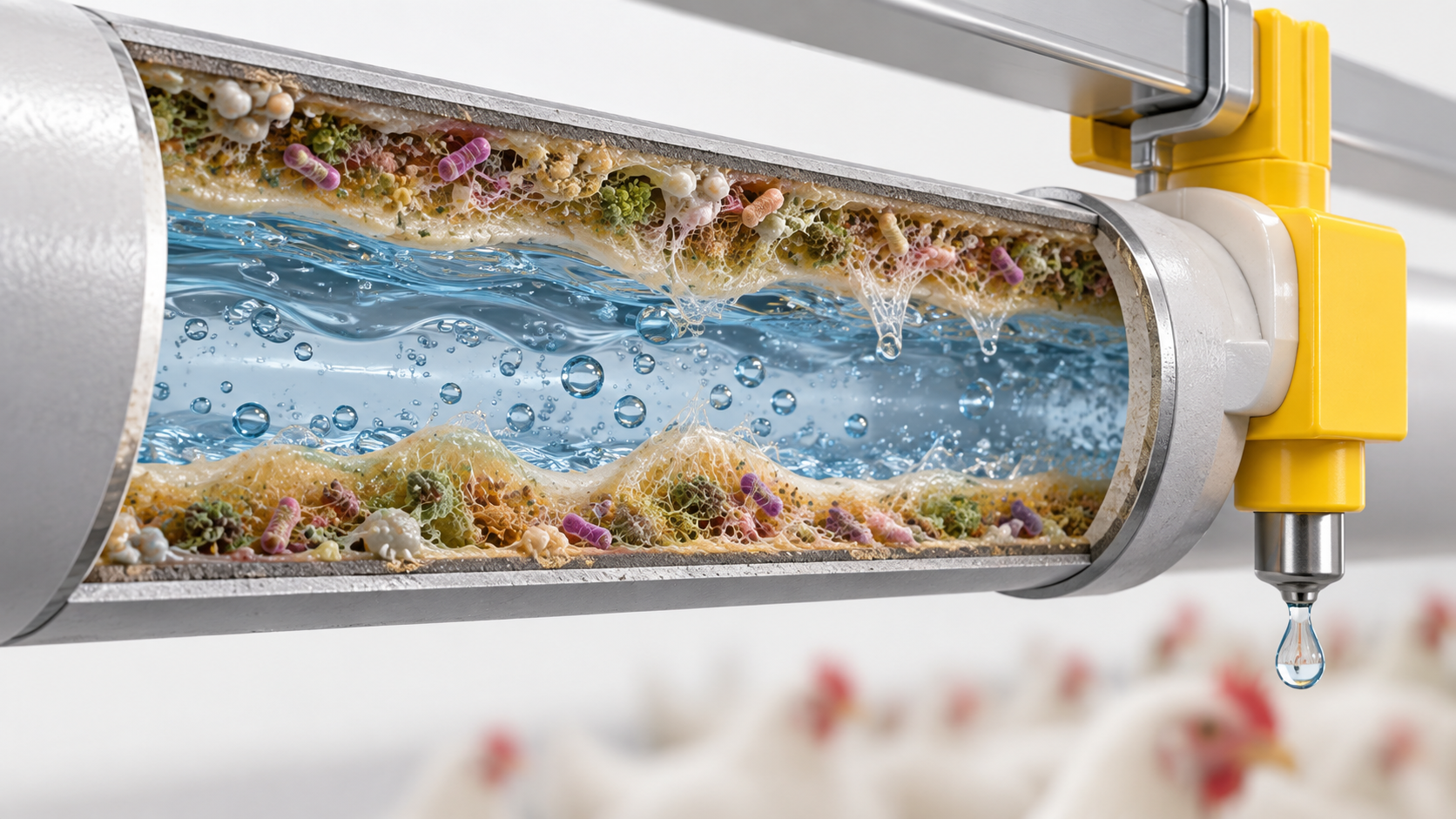
A laboratory report taken at the farm inlet describes only one sampling point. It does not describe what the bird finally drinks. Once water enters storage tanks and narrow, warm drinker lines, surfaces can accumulate minerals, organic residues and microbial communities embedded in a protective extracellular matrix: biofilm.
Biofilm changes the practical meaning of water hygiene. Water that meets microbiological specifications at the source may deteriorate before it reaches the nipple. In addition, deposits and organic material can consume disinfectant residuals and protect microorganisms from sanitation procedures.
From drinking line to gut environment
Water quality influences more than thirst. The drinking system is a direct interface between the farm environment and the gastrointestinal tract. Microbial contamination, excessive mineral load, poor sanitation or unstable water intake can alter the conditions under which the intestinal barrier and microbiota function.
This does not mean that every change in water chemistry will produce a measurable gut-health disorder. The response depends on concentration, duration, bird age, diet composition, environmental temperature and the existing microbial pressure. The practical point is that water should be evaluated as one component of the total intestinal environment rather than as an isolated utility.
When water intake falls, feed intake often follows. When water consumption rises unexpectedly, the cause may involve heat stress, dietary electrolyte balance, disease, leakage or other management factors. Daily water-use data therefore provide useful context for interpreting FCR, litter condition, uniformity and health observations.
Sanitation is a process, not a single treatment
Effective water hygiene depends on more than adding a disinfectant. Storage tanks, dead ends, pressure regulators, filters, medicators and drinker lines must all be considered. Organic matter, mineral scale and established biofilm can reduce the effectiveness of sanitation and create uneven conditions along the system.
Cleaning between flocks should therefore aim to remove both mineral and organic deposits before final disinfection. During production, sanitizer concentration or oxidation-reduction potential should be checked at more than one point whenever possible, especially at the end of the drinking line where residual activity may be lowest.
Practical monitoring points
- Test water at the source, after storage or treatment, and at the end of the drinking line.
- Record daily water consumption and compare it with feed intake, bird age and ambient temperature.
- Inspect tanks, filters, regulators and line ends for sediment, scale and organic residues.
- Interpret sanitizer residuals together with pH, organic load and contact time.
- Investigate sudden changes in water use before assuming the cause is nutritional.
Water as a delivery route for nutritional and gut-health interventions
Drinking water is increasingly used as a delivery route for probiotics, organic acids, phytogenic compounds, vitamins, amino acids and other supportive interventions. A 2026 systematic review evaluating water-delivered additives in poultry grouped reported effects into four main areas: epithelial function and digestion, immune modulation, oxidative status and microbiota [3].
The practical implication is straightforward: the biological response to a water-delivered product depends not only on the product itself, but also on water chemistry, dosing accuracy, line cleanliness, contact time and compatibility with disinfectants or other additives. A technically sound intervention can underperform if the delivery system is unstable.
For this reason, water programs should be designed together with the farm’s sanitation protocol. Acids, oxidizing agents, vaccines, probiotics and other products should not be combined automatically. Compatibility and sequencing matter, and manufacturer instructions should be followed carefully.
What should trigger investigation?
The first sign of a water-related problem is not always a failed laboratory test. In commercial flocks, changes in consumption pattern can appear before obvious clinical signs. A deviation from the expected water:feed relationship, uneven drinking activity, increasing litter moisture, declining feed intake, pressure differences across the line, or repeated microbial findings at line ends should prompt further investigation.
Sampling should then move beyond the farm inlet. Comparing source water, tank water and end-of-line water can help identify where deterioration occurs. When microbiological counts increase only after storage or inside the house, the problem is likely to be within the distribution system rather than the original source.
A useful diagnostic question
If feed formulation, health status and environmental management appear acceptable but growth or intake remains below expectation, ask: Is the bird receiving the same water quality that was measured at the source?
Practical conclusion
Water quality should not be treated as a secondary farm parameter. In high-performing broiler systems, water supply, chemistry, microbiological status and drinking-line hygiene interact directly with feed intake, gut function and flock performance.
The most useful management approach is therefore not to rely on one laboratory result, but to monitor the full path from source to bird. Source-water chemistry, storage conditions, line cleanliness, sanitizer performance, temperature, flow and consumption trends should be interpreted together.
When performance falls below expectation despite a technically sound feeding program, water deserves the same level of investigation as feed, health and environmental management.
References
- Recent review on poultry drinking-water quality, physicochemical parameters, microbiological control and performance, 2026.
- Raut et al. Effects of chronic exposure of specific water quality parameters in poultry drinking water on dietary amino acid digestibility and early broiler performance. Poultry Science, 2025.
- Correa F, Luise D, Simongiovanni A, Lecuelle S, Trevisi P. Additives delivery through drinking water to support gut health in swine and poultry: a systematic literature review. Animal. 2026;20(5):101822.
- Aviagen. Ross Broiler Management Handbook. 2025.
- Aviagen. Ross Broiler Pocket Guide. 2025.
- Aviagen. Gut Health on the Farm Guide. 2025.
- Cobb-Vantress. Technical guidance on broiler drinking-water quality and water-system management.
- World Health Organization. Guidance on drinking-water quality and microbiological risk management.
Dr. Reza Atar Oliay
Founder & Managing Director, Atar Nutrico GmbH
Dr. Reza Atar Oliay is a veterinarian with extensive international experience in poultry production, nutrition and farm management. His work focuses on practical, science-based approaches to animal nutrition, feed additives, gut health and production efficiency.
This article is intended for professional and educational use. Farm-level decisions should consider local water analysis, bird age, management conditions, product instructions and applicable regulations.